
A dental filling repairs tooth structure that has been damaged by decay, but it does not make the tooth permanently immune to cavities.
Years after a tooth has been restored, you may notice sensitivity, discomfort, food catching around the area, or another change and wonder whether new decay under a filling could be responsible.
It is possible for new decay to develop around an existing restoration or in nearby natural tooth structure. In some cases, decay may extend beneath the filling as well.
That does not automatically mean the original filling failed or that you did something wrong. Restored teeth still need ongoing care, and several factors can contribute to new decay over time.
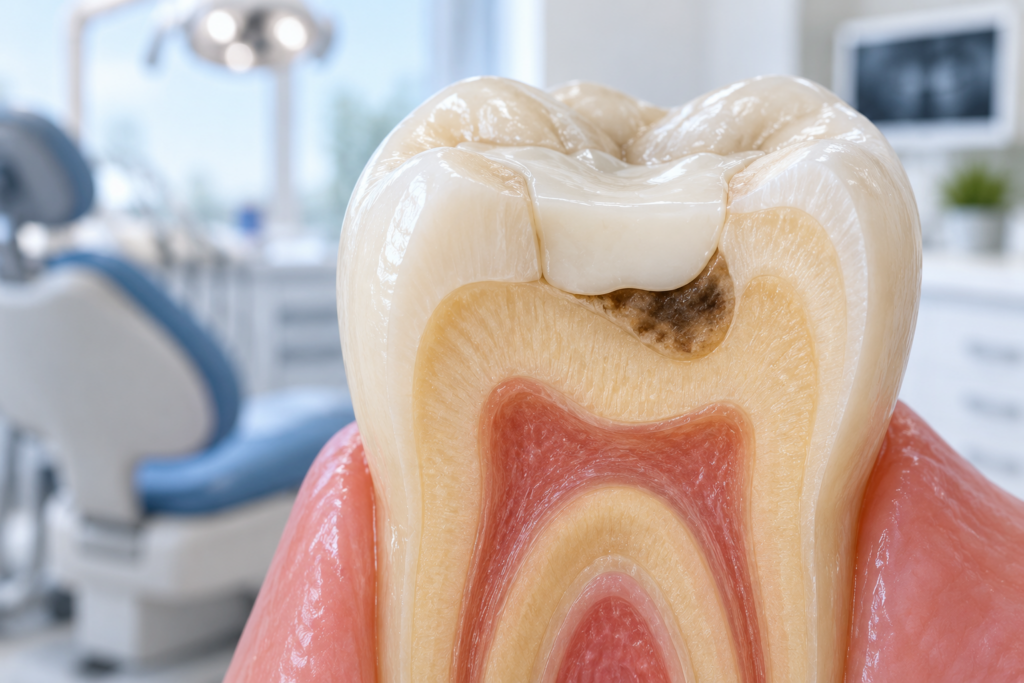
What Does Decay Under a Filling Mean?
When people say they have decay “under” a filling, they may be referring to several different situations.
New decay might develop:
- Near the edge of the restoration
- In the tooth structure immediately surrounding it
- In another part of the same tooth
- Beneath part of the existing restoration
You generally cannot determine the exact location from symptoms alone.
A dentist needs to evaluate the restoration, surrounding tooth structure, symptoms, and other clinical information to understand what is happening.
The important point is that the filling itself replaces or repairs only part of the tooth. The rest of the natural tooth remains susceptible to decay.
Why Can Decay Develop Around an Existing Filling?
A restored tooth continues to be exposed to the same oral environment as the rest of your teeth.
Plaque, bacteria, food debris, diet, dry mouth, oral hygiene habits, and individual cavity risk can all affect the tooth around the restoration.
Decay may also begin near the border where the filling meets natural tooth structure.
This does not mean the filling itself “caused” the cavity. Instead, decay develops when susceptible tooth structure is exposed to conditions that allow the cavity process to occur.
Restorations can also change over time, which is one reason dentists continue to monitor both the filling and surrounding tooth during routine care.
An older filling does not automatically mean that the tooth will develop decay. Many restorations continue functioning appropriately for years. What matters is the condition of the individual tooth and restoration.
What Are the Signs of Decay Around a Filling?
New decay around a filling can sometimes cause noticeable symptoms.
Possible changes include:
- New sensitivity to hot or cold
- Tooth pain
- Discomfort when biting
- Food repeatedly catching near the filling
- A rough or unusual area around the restoration
- A visible change in the tooth or filling
- A change in how the restored tooth feels
These symptoms do not prove that decay is present.
Sensitivity, bite discomfort, roughness, or pain can have several causes. The filling itself, surrounding tooth structure, gums, bite, or another dental condition may be involved.
That is why an examination is more useful than trying to diagnose the problem based only on how the tooth feels.
Can Decay Form Without Causing Pain?
Yes.
Some cavities and other dental changes can develop before a patient notices significant discomfort.
A filled tooth may therefore feel completely normal even when the dentist identifies a change during a routine examination.
The absence of pain does not guarantee that the restoration and surrounding tooth are problem-free.
This is one reason regular dental visits continue to matter after a filling has been placed. Monitoring gives the dental team an opportunity to evaluate changes before symptoms become the only signal that something may be wrong.
How Does a Dentist Check a Filled Tooth for Decay?
The evaluation usually starts with the tooth itself.
The dentist may examine:
- The existing filling
- The edges of the restoration
- Surrounding tooth structure
- Nearby gums
- Your bite
- Any area associated with sensitivity or discomfort
Your symptoms and dental history also provide useful context.
When additional information is needed, digital dental X-rays may help evaluate areas that cannot be fully assessed through a visual examination alone. Digital X-rays are part of the practice’s confirmed preventive and diagnostic services.
Imaging is only one part of the evaluation. An X-ray does not guarantee that every area of decay will be visible, so the dentist considers imaging together with the clinical examination and other findings.
Does Decay Around a Filling Always Mean It Needs Replacement?
No.
Finding new decay around a restoration does not automatically mean the entire filling must be removed and replaced.
The dentist may consider:
- Where the decay is located
- How far it has progressed
- The condition of the existing filling
- How much healthy tooth structure remains
- Whether the tooth has symptoms
- Whether the existing restoration remains stable and functional
In some situations, replacing the filling may be appropriate.
In another situation, the dentist may determine that part of the restoration can be addressed without completely replacing it. A different restorative approach may also be considered if the condition of the tooth has changed significantly.
There is no single treatment that applies to every restored tooth.
When Might a Different Restoration Be Needed?
Sometimes a tooth that was previously restored with a filling has lost enough tooth structure that another filling may no longer provide the support the tooth needs.
In selected cases, a dental crown may be considered because it provides more extensive coverage of the tooth.
That does not mean every filling with new decay needs a crown.
The recommendation depends on factors such as how much healthy tooth structure remains, where the decay is located, the condition of the existing restoration, and the overall condition of the tooth.
The goal is to choose a restoration that matches what the individual tooth needs rather than automatically moving to the most extensive option.
Dental fillings and crowns are both confirmed restorative services for the practice.
How Can You Reduce the Risk of Decay Around a Filling?
Good oral hygiene can reduce cavity risk, but it cannot guarantee that a filled tooth will never develop decay again.
Cavity risk can be influenced by:
- Plaque buildup
- Frequent sugar exposure
- Diet
- Brushing and interdental cleaning
- Dry mouth
- Individual susceptibility
- The condition of the tooth and restoration
Developing a new cavity does not automatically mean you have failed to care for your teeth.
Instead, prevention focuses on reducing factors that can be changed while continuing to monitor restored teeth over time.
Helpful habits may include:
- Brushing consistently
- Cleaning between the teeth
- Following individualized home-care recommendations
- Limiting frequent exposure to sugary foods and drinks
- Drinking water regularly
- Keeping routine dental appointments
- Mentioning changes in a previously filled tooth
Ongoing preventive dental care can help your dental team monitor restorations and identify areas that may benefit from additional attention.
When Should You Have a Filled Tooth Checked?
A previously filled tooth is worth mentioning if something noticeably changes.
Consider scheduling an evaluation if you develop:
- New or persistent sensitivity
- Tooth pain
- Pain when biting
- A rough or damaged-feeling restoration
- Food repeatedly catching near the filling
- A visible change in the tooth
- Another symptom that concerns you
Do not try to repair, smooth, or alter a filling yourself.
You also do not need to wait until the tooth becomes severely painful. An evaluation can help determine whether the change is related to new decay, the restoration itself, the bite, surrounding tissues, or another dental issue.
A Filling Does Not Make a Tooth Immune to Decay
A filling repairs tooth structure that has already been affected by a cavity. It does not permanently protect the rest of the tooth from developing decay in the future.
New decay may form near the edge of a restoration, in surrounding tooth structure, or sometimes beneath the filling.
That does not automatically mean the original filling was unsuccessful or that you did something wrong.
What matters is identifying what has changed and determining what, if anything, needs to be done next.
We focus on gentle dentistry, patient education, prevention, and individualized treatment planning. These priorities are central to the practice’s patient-care approach.
If you have noticed a change in a previously filled tooth, contact us to schedule an evaluation and discuss what you have noticed.